ACL Rehabilitation: Your Complete Recovery Guide
An ACL injury doesn’t mean the end if your sporting journey
Tearing your Anterior Cruciate Ligament (ACL) can feel overwhelming, especially if you’re active or play competitive sport. Questions like “Will I ever play again?” or “How long will recovery take?” are completely normal.
The good news is that modern rehabilitation, guided by evidence-based practice, has helped thousands of people successfully return to sport, work and everyday life.
At Horn Rehab & Performance, we believe successful ACL rehabilitation isn’t about rushing back, its about returning stronger, more confident and reducing the risk of another injury.
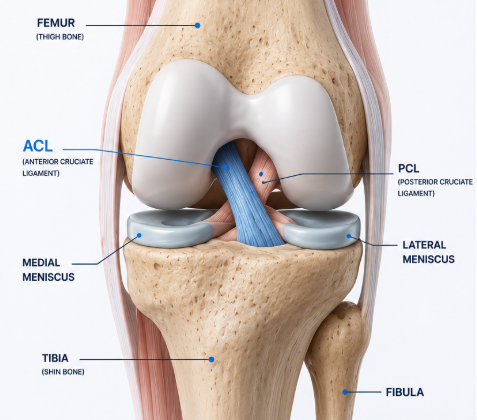
What is the ACL?
The ACL (anterior cruciate ligament) is one of the main stabilising ligaments inside the knee.
Its primary roles are to:
Prevent the shin bone from sliding forward.
Control twisting and rotation movements.
Provide stability during cutting, pivoting and landing.
Help the brain understand where the knee is in space (proprioception).
Sports such as rugby, football, netball, hockey and basketball place high demands on the ACL because they involve rapid changes in direction, jumping and sudden deceleration.
How does an ACL tear happen?
Most ACL injuries occur without direct contact.
Common situations include:
Landing awkwardly after jumping.
Twisting while the foot is planted.
Changing direction quickly.
Sudden deceleration.
A direct tackle forcing the knee inward.
Many people describe hearing or feeling a “pop” followed by swelling within the first few hours.
Do you always need surgery?
Not always.
Treatment depends on:
Your age.
Activity level.
Sporting goals.
Knee stability.
Associated injuries (such as meniscus damage).
And your personal goals.
For people wanting to return to pivoting sports such as rugby, football or netball, ACL reconstruction is often recommended. Other may achieve excellent outcomes through structured rehabilitation.
This decision should alway be made in consultation with your orthopaedic surgeon and rehabilitation team.
How long does ACL rehabilitation take?
This is one of the most common questions patients ask.
Recovery isn’t determined simply by time, it depends on meeting specific milestones.
Most people can expect:
Stage Approximate time ——————————————————————————-
Walking comfortably - 2-6 weeks
Regaining full movement - 6-12 weeks
Strength rebuild - 3-6 months
Running progression - Around 4-6 months (if criteria is met)
Agility and jumping - 6-9 months
Return to competitive sport - Usually 9-12+ months
Recent research shows that returning to high-level sports too early increases the risk of re-injury. Your progression should always be guided by objective testing rather than the calendar alone.
The rehabilitation journey
Rather than thinking in terms of weeks, rehabilitation is best viewed as a series of phases. You only move forward once the goals of the current phase have been achieved.
Phase 1 - Protect and restore
Goals:
Reduce pain and swelling.
Restore full knee extension.
Improve knee bending.
Activate the quadriceps.
Walk with good movement quality.
At this stage, the focus is on creating the best possible environment for healing.
Phase 2 - Build strength
Goals:
Restore muscle strength.
Improve balance and control.
Develop confidence.
Normalise movement.
Exercises become progressively more challenging while ensuring the knee tolerates increasing loads safely.
Phase 3 - Running and power development
Goals:
Begin running progression.
Build explosive strength.
Improve landing mechanics.
Restore confidence during faster movements.
Running begins only once specific strength and movement criteria have been achieved, not simply because a certain number of weeks has passed.
Phase 4 - Sport specific training
Goals:
Sprinting.
Cutting.
Acceleration.
Deceleration.
Jumping.
Change of direction.
Position specific drills.
Training now begins to resemble the demands of your chosen sport.
Phase 5 - Return to performance
Goals:
Pass returning to play testing.
Demonstrate excellent movement quality.
Restore strength symmetry.
Regain confidence.
Return safely to competition.
The aim isn’t just to return to playing, it’s to return performing at your best.
Why objective testing matters
At Horn Rehab & Performance, we believe decisions should be based on measurable data rather than guesswork.
Objective testing allows us to monitor:
Strength.
Power.
Limb symmetry.
jump performance.
Landing mechanics.
Functional movement.
There results help determine whether your knee is truly ready to progress to the next phase of rehabilitation.
When should you see a Biokineticist?
A Biokineticist plays a key role in bridging the gap between medical treatment and returning to normal life or sport.
Our role includes:
Designing a personalised rehabilitation program.
Progressing exercises safely.
Monitoring objective improvements.
Identify movement deficits.
Guiding return to running and return to sport progression.
Performing return to play testing.
Helping reduce the risk of future injury.
Every rehabilitation programme is tailored to your goals, whether that’s walking comfrotably, returning to work or competing at the highest level.
Ready to being your recovery?
Whether you’ve recently injured your ACL, undergone surgery or are preparing to return to sport, we’re here to guide you through every stage of rehabilitation.
Book an assessment with Horn Rehab and Performance and take the first step towards a safe, confident return to activity.